Sunday, July 12, 2015

The Coming Market Correction?


In mid-May I wrote a piece in the blog entitled, “A Slowing Economy and a Wall of Worry”. I cited worries about the lack of strength in retail sales, softer than expected consumer confidence numbers, the abysmal Atlanta Fed GDP forecasts and the declining Citigroup U.S. Economic Surprise Index as evidence that there may be significant cracks starting to show in the economy.

Of course I stopped short of trying to make a market call at that time as I don’t have the luxury of such clairvoyance. I pointed these items out as an adjustment to risk management in one’s portfolio. “There is always the treat of a correction or bear market on the horizon but it is truly impossible to forecast when it will happen. In the cases of market “bubbles”, market sentiment has much more influence on asset prices than intrinsic values. Attempting to time market tops and bottoms is a futile and unprofitable strategy in my opinion. Understanding the fallacy of the Efficient Market Hypothesis and the Efficient Frontier and embracing the influence investor behavior can have on market valuations is one of the hardest parts of investing. We have written in the past about our concerns about the market valuation but have an equally sound concern about missing potential market gains by ignoring the power of investor sentiment. The proper use of portfolio risk management while maintaining equity exposure is the most prudent option right now, in our opinion.”

Fast-forward to the beginning of July

I received a call from my good friend Joseph the other day and we had one of our ever-insightful conversations about the current state of the economy and the markets. Joseph has a unique perspective on the economy as he is on the front line of two of the most economically sensitive sectors, transportation and construction. His knowledge of these two industries is a derivative of the type of business that he runs – moving construction and demolition debris by rail. He made a comment that business is very strong – the strongest he’s seen in years and that the “economy is doing fine”.

Indeed rail traffic and the recent move in lumber prices certainly confirm his thoughts.


The Federal Reserve Bank of Atlanta’s GDPNow – which nailed it with their 1Q15 GDP projections has shown marked improvement from May. “The GDPNow model forecast for real GDP growth (seasonally adjusted annual rate) in the second quarter of 2015 was 2.3 percent on July 7, up from 2.2 percent on July 1. Following this morning's international trade release from the U.S. Census Bureau, the nowcast for the contribution of net exports to second-quarter real GDP growth increased from -0.2 percentage points to 0.1 percentage point.”
 
The Citigroup U.S. Economic Surprise Index is also starting to trend higher as economists’ projections and actual economic performance move further in line.
 
 
Market Correction
There has been a slew of analysis saying our equity market is in bubble territory and that it is way overdue for a correction of sorts. I not only agree with that synopsis but welcome a correction as it will allow for portfolio adjustment and the opportunity for increased alpha. Based on Bloomberg data, the companies that comprise of the S&P 500 are expected to show $125.71 in earnings per share over the coming twelve months and have a current earnings yield of 6.1%. Book value per share for the index is $736.68 with a BV yield of 35.4% and cash flow per share of $180.23 for a CF yield of 8.8%. If we weight each valuation measure according to accuracy in predicting future price movements our blended fair value for the S&P 500 is $1702 or about 18% overvalued.

 
I am on board with the market overvaluation camp but not the imminent correction folks. The question that I have is what will be the catalyst that sparks the correction. So assuming the economy is still growing, albeit at a subdued pace and that growth shows little signs of trailing off at this time we will rule out a recession as the cause for correction. Tightening monetary policy comes to mind, but given the length of time with a ZIRP in place, even a September increase by the Federal Reserve can still be considered nothing less than accommodative.
Perhaps the correction will manifest itself through a non-U.S. event. I agree with John Mauldin when he writes, “For some time now, I’ve been saying that the US economy should bump along in the Muddle Through range of about 2% GDP growth. The risk to that forecast is not from something internal to the United States but from what economists call an exogenous shock, that is, one from outside the US. In particular I have said that a crisis in both Europe and China at the same time would be very negative for both US and global growth. We now see potential crises in both regions. It would be convenient if they could arrange not to have them at the same time. But those who are paying attention to global markets are certainly experiencing a bit of market heartburn as they watch both China and Europe manifest the volatility that they have over the last few weeks. I will become far less sanguine about the US economy if full-blown crises develop in those two regions.” Indeed we recently pointed out on this blog space that the events unfolding in China offer the greatest risks to the U.S. bull market in our view – even if temporarily.
Earnings Drought
Perhaps the genesis of the market decline will be rooted in the deterioration on corporate fundamentals, i.e. revenues and earnings. There are a fair share of financial engineering skeptics in the world of finance and admittedly all bring up excellent points. I read post from Wolf Street this weekend. He writes, “Now the bad news. Currently the S&P 500 companies are projected to report a year-over-year decline in earnings of 4.4% for the second quarter, on a revenue decline of 4.2%. Of the companies in the index, 24 have already reported, which nudged up the estimates at the beginning of Q2, when the earnings decline was pegged at 4.5%... If this estimated earnings decline of 4.4% is the final number for Q2, it will be the first decline since Q3 2012, when earnings dropped 1%, and it will be the largest decline since Q3 2009, when earnings plunged 15.5%. If the revenue decline of 4.2% is the final number for Q2, it would be the first such decline since Q3 2009. These are not exactly hot numbers. Don’t despair. Companies will beat these numbers with plenty of positive “earnings surprises” in the weeks to come, given all the expert financial engineering that goes into these numbers. But they might not be able to beat them by enough to get them into the green. Over the last four years, actual earnings were on average 2.9 percentage points higher than estimates at the beginning of the quarter. If it works out this way for Q2, earnings would still decline by 1.6%, which would still be the worst earnings debacle since the Financial Crisis. However the final outcome, what’s striking are the trends of earnings estimates at the end of the quarter and of actual earnings “growth” – both of which have been heading south for over a year and are now, despite all expert financial engineering, turning negative”
 
I agree that there has been a decrease in the quality of earnings of late. It takes quarters and years of deterioration to impact the market in a major way and yes this bull market is long in the tooth. One item that concerns me is corporate profit margins. Looking at the figures below, one can see that trailing twelve month revenues and earnings have been leveling off as have profit margins. Prior to the dot.com bust in 2000, corporate margins for the S&P 500 peaked at around 8%. Remember, earnings didn’t matter in the late 90’s so one wouldn’t expect excessive margin expansion for that time. But looking prior to the 2008 crash, margins peaked near 10% before retreating in a big way. We are leveling off at nearly 10% net margins today and I’m curious as to how we will get increased margin expansion from this this point. Ultimately I’m a believer in mean reversion and believe margins will contract over time. I’m just not sure if it’s going to happen sooner rather than later.
There are compelling views that I have read that justify current profit margins as a function of secular shifts in corporate America. A “new normal” if you will (I truly dislike that term). This post from Philosophical Economic entitled Profit Margins in a “Winner Take All” Economy is an interesting read. They write, “With yet another quarter now on the books in which profit margins have remained steady at record highs, it’s becoming increasingly difficult for open-minded investors to reject the possibility that “this time is different”–i.e., the possibility that the observed profit margin increase relative to past averages is secular in nature, and that the much-awaited mean reversion isn’t going to happen.” The theory behind the secular shift in margins has to do with a limited concentration of businesses within a certain sector, i.e. higher barriers to entry and specialization. “Barriers to entry keep competition out.  As they get stronger, the players protected by them are able to successfully operate at increased levels of profitability, free from the threat of competition. This brings us to the “Winner Take All” economy.  The point is difficult to quantify or conclusively prove, but it seems that the dramatic technological changes of the last 20 years have made credible competition in certain key sectors of our economy more difficult, and have allowed dominant best-in-breed companies–the $AAPLs, $GOOGs, $MSFTs, $FBs, and so on of the world–to command sustainably higher profit margins. The current U.S. economy seems to have more genuine monopolies than the economies of old–more companies that face little to no competition. The increase in monopoly businesses and monopoly products seems be due, at least in part, to the massive distributional, network-creative and network-protective power of the internet, and also the shift towards the production of non-physical things.  A first-mover with a strong intangible product can distribute that product to the entire world at little cost, protect it as intellectual property, and build a profitable user network around it that other corporations will have an exceedingly difficult time competing with.”
The author goes on to prove this hypothesis. “Now, there is a clever way to test the hypothesis, which brings us to the theme of this piece.  If a “Winner Take All” economy, where increased barriers to entry–first-mover barriers, network barriers, patent barriers, size barriers, tax-advantage barriers, regulatory barriers, and so on–have allowed an increasingly concentrated group of dominant companies to earn substantially higher profit margins and push up on the aggregate profit margin, is the main driver of the aggregate profit margin increase, then we should expect the following.  If we separate the market into different tiers of profit margins, we should expect the higher tiers to have seen larger increases in their profit margins in recent decades than the lower tiers.  Increases in the profit margins of the higher tiers–at the expense of the lower tiers–would represent the “Winner” gradually “Taking All.””
The results were as the author expected and those specialized, high barrier to entry tiers had seen sustained increases in the profit margins. It’s a fascinating study and I believe it will be relevant on mitigating margin erosion for the markets on the whole, but I was never a fan of the “this time it’s different” mantra (another term not to my liking).
 
Given the margin analysis it’s also beneficial to look at the quality of earnings that are produced within the S&P 500. I like to track the index net operating income less its cash flow from operating and investing activities. One can then scale it by total index assets for easier cross index comparisons but for simplicity the chart below is shown as a z-score or where it lies on the bell curve. Knowing how much of reported earnings is supported by cash received versus accrued is key when using financial ratios and attaching a multiple to determine fair value.
When the earnings quality line is falling, then earnings quality is deteriorating. When it’s rising then it an earnings quality improvement. Notice both the market tops in 1999 - 2000 and 2007 – 2008 correlated with a -4 reading in the EQ chart. While earnings quality currently is deteriorating, it is nowhere near the dangerous levels of the previous two bear markets. For all the talk about sinister financial engineering used to goose profits, it appears to me that there is still some wiggle room to continue down this road for a while longer.
 
To Summarize
Do I think the U.S. stock market is overvalued by nearly 20% – YES.
Do I think we are in need of a correction to realign our portfolio for better alpha generating opportunities – YES.
What will be the catalyst that sparks the correction – I have no idea but will be prepared when it does happen.
Will an economic slowdown/recession be the cause of the correction – NO, not at this time.
Will an earnings recession and a breakdown in profit margins be the cause of the correction – NO, not at this time.
Will a China/Greece financial crisis be the cause of the correction – It’s possible.
Bottom Line: We continue to take a cautionary stance towards the market but remain invested. As we stated in previous writings, “We wrote a few weeks ago that we agreed with the general consensus that the market appears overvalued. That said, the market is a function of intrinsic value AND market sentiment. We have a cautious outlook but understand that market sentiment can be a powerful force. The trend is up and will most likely continue until there is a catalyst that changes that direction.”
In fact, given the recent turn of events we are getting slightly more bullish on equities for the second half of the year. More on that to follow.
Joseph S. Kalinowski, CFA
No part of this report may be reproduced in any manner without the expressed written permission of Squared Concept Partners, LLC.  Any information presented in this report is for informational purposes only.  All opinions expressed in this report are subject to change without notice.  Squared Concept Partners, LLC is an independent asset management and consulting company. These entities may have had in the past or may have in the present or future long or short positions, or own options on the companies discussed.  In some cases, these positions may have been established prior to the writing of the particular report. 
The above information should not be construed as a solicitation to buy or sell the securities discussed herein.  The publisher of this report cannot verify the accuracy of this information.  The owners of Squared Concept Partners, LLC and its affiliated companies may also be conducting trades based on the firm’s research ideas.  They also may hold positions contrary to the ideas presented in the research as market conditions may warrant. 
 This analysis should not be considered investment advice and may not be suitable for the readers’ portfolio. This analysis has been written without consideration to the readers’ risk and return profile nor has the readers’ liquidity needs, time horizon, tax circumstances or unique preferences been taken into account. Any purchase or sale activity in any securities or other instrument should be based upon the readers’ own analysis and conclusions. Past performance is not indicative of future results.


Wednesday, July 8, 2015

China's Turmoil and PGM


Chinese shares continued their downward trend last night with the Shanghai Composite falling almost 6%. The CSI 300, the largest listed firms on both the Shanghai and Shenzhen exchanges fell almost 7%. We wrote yesterday on the enormous efforts of the Chinese authorities to stem the losses but it appears panic selling has taken hold in a “dot.com-like” bursting of their market. Now it appears the panic selling is starting to bleed over into other regional markets. Hong Kong’s Hang Seng closed 23,516.56 down 5.8% and Australia’s ASX200 closed 5,469.53 down 2%. Japan’s Nikkei closed $19,737.64 off 3.1%. Other regional markets that suffered a bout of selling include Malaysia, Philippines, Singapore, South Korea, Taiwan, Thailand…you get the picture. Every index suffered rather large losses for the day. The fear of panic selling contagion is real and as we stated yesterday, if the financial, economic and social well-being of the world’s second largest economy becomes unglued, we can see that selling pressure come to our shores and impact our stock market.

Precious Metals

I have written several times in the past about the virtues of owning precious metals and platinum and palladium in particular.

My musings on PGM:


11/9/14 - Platinum Update

11/23/14 - PGM Update


Since I started writing about these industrious precious metals, both Platinum and Palladium are down approximately 16% and 13%, respectively. Admittedly not the greatest of calls. That said, we are still believers in the fundamental reasons for ownership in these metals and more importantly, despite the declines in the metals and the overall commodity space, we are still able to show gains for our investors in our metals trading division.

So what’s happening to these metals?

Much of the decline is rooted in the decline in the Chinese stock markets. We have written about the global supply and demand issues in the past and will reiterate our thesis.


Demand Dynamics

On the demand side, prices for these precious metals are largely tied to auto sales given their high concentration of usage in catalytic converters. The global outlook for vehicle sales has been fairly robust of late in spite of the global economic slowdown that we are witnessing. Global auto sales in 2014 have been just under 80 million vehicles sold of which sales in Asia have been leading the way. North America represents approximately 27% of the worldwide auto market. Western Europe is 17% of the global auto market and South America consumes 6%. Eastern Europe makes up 5% of the global auto market. 

Clearly the highest area of growth in auto sales has been in Asia. Approximately 32 million vehicles sold in Asia is over 40% of global auto production and China has been the driver of Asian auto sales at just over 18 million units sold. 
 
 
Analysts had been expecting the global auto market to growth at a 2% clip over the next several years as additional monetary stimulus in Europe and Asia are implemented to assist their economies gain traction. The recent events in China may be changing that. I read an article last night from BloombergBusiness entitled, “China’s Stock-Market Rout Puts Car Sales in ‘Meat Grinder’” In the article they make several good points about the link between Chinese market participants and the auto industry. This of course connects a direct line between the Chinese markets and the price of PGM. The chart below shows NYSE Arca China Index (red and white candlesticks) with a palladium overlay (black line). I haven’t checked the official “fit” between the two but if you eye-ball it, one can see a rough correlation.
 
 
Due to the declining markets in China, “An increasing number of car buyers in China are canceling their purchases and risking forfeiture of their down payments after a stock-market rout that has erased about $3.2 trillion in value, according to Cui Dongshu, secretary-general of China’s Passenger Car Association. “The plunging stock market is essentially a meat grinder, shredding money meant for buying cars,” Cui said in a phone interview. Auto sales fell last month for the first time in more than two years, according to figures released by the group Wednesday.”
They go on to say, “Dealers who reported softening demand as prospective buyers postponed their purchases during the rally to punt on equities now face the prospect of lost sales in the ensuing plunge. “The stock market is going down too fast, this is wealth destruction,” said Song Yang, a Hong Kong-based analyst at Barclays Plc. “If you’re losing so much money in the stock market, that dampens your desire to buy a car.””
Auto makers are cutting prices in China to retain market share but that seems like a futile effort if folks are just postponing auto purchases until the market rout ends. Regarding pricing cuts and product-mix revamping, “That’s done little to spur demand, with a survey by MNI Indicators showing the proportion of consumers who planned to buy a car shrinking last month. Inventory was at levels that indicate low market demand for nine consecutive months, with June’s reading at the second highest mark for this year, data from the China Automobile Dealers Association show. Weak car demand is not expected to recover before September, according to Cui, who also said it is unlikely for the government to roll out any policy incentives to help spur vehicle demand in the near future. An estimated $2.6 trillion of shares, or about 40 percent of the market’s capitalization is now locked through trading suspensions by companies on the two Chinese exchanges, according to data compiled by Bloomberg.”
Trading PGM
The way we trade the PGM space is a bit unique and has for the most part sheltered us from precipitous declines in our portfolio. Even with the financial pandemonium taking place in China, demand for the metals exists and primary (mining) supplies are not able to meet that demand.


Much of the shortfall in supply is found in the secondary recycling market. As automobiles are scrapped, the catalytic converter is removed and the precious metals contained within (platinum, palladium and rhodium) are extracted and recycled. By running a disciplined trading approach, there are exceptional ROIC characteristics at play.
The fall in the commodity arena has also claimed the prices of base metals. This is the key pricing variable for individuals that own auto scrap yards. Given the lean margins and lower price points, the fall in these metals is currently hurting those in the scrap metal space. Even with the recent declines in precious metals pricing, the recovered auto catalyst holds the greatest value per pound in all the material in the yard. So as commodities and base and scrap metal in particular has been declining, we have seen a greater willingness for these yards to sell the auto catalysts to help mitigate the scrap metal downturn. For the precious metal recyclers that we run the hedge book for, business has been accelerating.
Using a ratio of CTFC NYMEX open commercial long to short contracts is useful in trading for the purposes of the hedge book. Taking this ratio and seeing where it lies on the bell curve using a z-score gives us the directional bias. When the one month commitment of traders’ algorithm rises above 1.0, then the directional bias of the metal is higher. When it falls below -1.0, then the bias is lower.

 
When buying recycled precious metals from the secondary market, one can take advantage of buying the metals for a few percentage points below the published bid for an instantaneous arbitrage sale. To keep the trading margins intact, one much protect those margins against commodity risk.
When the metals bias is higher the trade is as follows. Keep a naked position for physical delivery and protect your downside using put options on the futures of the underlying metals. When the metals bias is lower, take a forward sale locking in your physical delivery sale price and protect yourself from an upward movement in the underlying using a call back spread option strategy with a credit spread in place.
Being able to trade around your positions mitigates the risk of just buying and holding the underlying metal (something we are still willing to do) by providing a stream of income to offset the correction we are seeing in platinum and palladium.
Bottom Line: We are still believers in the underlying fundamentals of PGM ownership but understand that market sentiment is unfavorable. That said we are still able to produce returns on invested capital to offset any near-term market turbulence.
Joseph S. Kalinowski, CFA
 
No part of this report may be reproduced in any manner without the expressed written permission of Squared Concept Partners, LLC.  Any information presented in this report is for informational purposes only.  All opinions expressed in this report are subject to change without notice.  Squared Concept Partners, LLC is an independent asset management and consulting company. These entities may have had in the past or may have in the present or future long or short positions, or own options on the companies discussed.  In some cases, these positions may have been established prior to the writing of the particular report. 

The above information should not be construed as a solicitation to buy or sell the securities discussed herein.  The publisher of this report cannot verify the accuracy of this information.  The owners of Squared Concept Partners, LLC and its affiliated companies may also be conducting trades based on the firm’s research ideas.  They also may hold positions contrary to the ideas presented in the research as market conditions may warrant. 
 
This analysis should not be considered investment advice and may not be suitable for the readers’ portfolio. This analysis has been written without consideration to the readers’ risk and return profile nor has the readers’ liquidity needs, time horizon, tax circumstances or unique preferences been taken into account. Any purchase or sale activity in any securities or other instrument should be based upon the readers’ own analysis and conclusions. Past performance is not indicative of future results.


Tuesday, July 7, 2015

Chinese Equities are a Problem


In my opinion, the massive stock selling in China, which has garnered much less media attention than the Greek drama is the more serious situation. The People’s Bank of China have cut rates and lowered bank reserve requirements to provide support for the stock market that can’t seem to catch a bid.

For the past year, folks have been trading Chinese markets like day traders and the volatility is astonishing for a stock index. Both the Shanghai and Shenzhen stock exchanges more than doubled in a less than a year and both are now off their highs and in bear market territory in a blink of an eye. This precipitous sell-off is cause for concern and the speculative “risk-off” trading demeanor does have the potential to spread to other markets. That said, the Chinese regulators are throwing everything at the market in order to prove a floor.  Aside from the rates cuts and lowered reserve requirements, “The securities regulator relaxed rules on margin financing, making it easier for investors to borrow cash to buy shares and reducing pressure on brokers to call in collateral. The government announced that state pension funds would allocate more cash to the stockmarket. Official media, playing the cheerleader as ever, talked up blue-chip stocks. It did not work: rather than boosting confidence, the series of moves carried a whiff of desperation. The market tumbled nearly 10% on Thursday and Friday.”

But wait, there’s more. According to a Bloomberg report via Business Insider, “According to a Bloomberg report on Saturday, officials are suspending Initial Public Offerings (IPOs) – as many as 28 on the Shanghai and Shenzhen stock exchanges – to deal with the tumble in stocks. Stopping new companies from going public in IPOs may reduce the flow of cash from existing stocks, Bloomberg notes. There was no information on how long this ban would last.”

That should be enough to quell market jitters right?

Another recent report out of Business Insider, “China's top 21 securities brokerages said on Saturday that they would collectively invest at least 120 billion yuan ($19.3 billion to help stabilize the country's stock markets after a slump of nearly 30 percent since mid-June.”

Surely stepping up efforts to support the world’s second largest economy’s stock market from cratering is a noble effort. If the growth in China falters then there will be global repercussions and that could be the spark that ignites the coming market correction.

Now this morning in Business Insider I read, “But now Chinese companies have decided to take matters into their own hands and they just found a better and easier solution — suspend the company's stocks from being traded at all. According to China's official financial news outlet The Securities Times, picked up by the Financial Times and Reuters, more than 200 companies just suspended their shares. This brings the total amount of shares suspended to 651 since June 29, which is worth 23% of the 2,808 companies listed on the Shanghai and Shenzhen exchanges.”

Added to that, “According to Xinhua, a daily trading limit for the CSI 500 index will be effective from Tuesday, the latest action by China’s financial regulators to prevent more losses. Overnight China’s financial futures exchange said it would limit investors’ daily purchases of CSI 500 index futures to 1,200 lots for rise and fall.”

That makes sense. When trying to stop the stock market from selling-off…stop all the market participants from selling. Of all the central banking financial engineering that we have seen over the past several years, the actions taking place in China is the most astonishing display of moral hazard yet. The attempts to shackle the invisible hand are on full display and it is this humble investors opinion that all these efforts will fail. It would be an excellent lesson in macroeconomics if the world’s second largest economy didn’t face economic, financial and social upheaval.   

That said, we believe China offers wonderful long-term investment prospects. Admittedly it cannot sustain the published 7% to 8% economic growth over the long-term but a more moderate 3% to 4% for the Chinese economy is still impressive and worth looking at through all this near-term volatility and market turmoil.

For full disclosure, as part of our 3Q14 Global Equity Program rebalancing, we added the iShares China ETF (MCHI) to our managed accounts program near $46 per share. While the position is still up 15%, we are starting to question its value-add prospects to the portfolio. The position is very small relative to the program portfolio but it may not make the cut at the next rebalancing. When looking at the daily and weekly charts we find the ETF is sitting near critical levels and may be near-term over sold.

Bottom Line: The near-term prospects may provide a bounce in the ETF but ultimately we believe there is little centralized regulation can do to stem a market correction. More importantly is the long-term concerns on the economic and financial stability in China. As such a key driver of global economic growth, a major economic, financial and social upheaval in China is enough to start the correction in U.S. equities that so many are talking about.


Joseph S. Kalinowski, CFA

No part of this report may be reproduced in any manner without the expressed written permission of Squared Concept Partners, LLC.  Any information presented in this report is for informational purposes only.  All opinions expressed in this report are subject to change without notice.  Squared Concept Partners, LLC is an independent asset management and consulting company. These entities may have had in the past or may have in the present or future long or short positions, or own options on the companies discussed.  In some cases, these positions may have been established prior to the writing of the particular report. 

The above information should not be construed as a solicitation to buy or sell the securities discussed herein.  The publisher of this report cannot verify the accuracy of this information.  The owners of Squared Concept Partners, LLC and its affiliated companies may also be conducting trades based on the firm’s research ideas.  They also may hold positions contrary to the ideas presented in the research as market conditions may warrant. 
 
This analysis should not be considered investment advice and may not be suitable for the readers’ portfolio. This analysis has been written without consideration to the readers’ risk and return profile nor has the readers’ liquidity needs, time horizon, tax circumstances or unique preferences been taken into account. Any purchase or sale activity in any securities or other instrument should be based upon the readers’ own analysis and conclusions. Past performance is not indicative of future results.

Sunday, July 5, 2015

Greece and the Market - Referendum "NO" is predicted


As I sit with my family enjoying our July 4th celebration I continue to keep an eye on the news coming out of Europe today. Of course I am referring to the Greek referendum on whether the people of Greece will accept the terms of a bailout. I have not written about the Greek crisis in the past as I feel it has been analyzed up and down and I really don’t have much to add in the debate. What I can say is that I feel the vote this weekend signifies the inability to continue down the path of ambiguity that has plagued this situation for years. The outcome of the crisis as it relates to Greece is important but the precedent that it sets within euroland is of more importance in my opinion.

Time will tell.

Starting with Greece

The folks at Business Insider summed up the situation as it relates to the referendum.  “Greeks who vote "yes" in the referendum will be casting a vote in favor of Greece remaining a part of the 19-member eurozone. The vote is an acceptance of bailout funds in exchange for Greeks agreeing to budget cuts and other austerity measures set forth by Greece’s three creditors—the International Monetary Fund, the European Central Bank and the European Commission. A majority of Greeks voting “yes” would also signal that the country has largely lost faith in Prime Minister Alexi Tsipras and his left-wing Syriza-led government. The outcome could force leaders to resign, which would usher in a new provisional government. Greek Finance Minister Yanis Varoufakis said on Friday that he will resign if Greeks back the bailout.”

The “yes” vote was thought to be the most likely outcome but the early results suggest otherwise. Both the U.S. and surprisingly enough the IMF have come out and are endorsing a debt restructuring proposal that would assist Greece during the continuing negotiations. The risk associated with a yes vote would most likely result in the resignation of Tsipras and usher in a replacement for the current Syriza-led government. The political uncertainty surrounding the change may ultimately increase market volatility and keep it on unsettling footing as the negotiations continue.

According to Business Insider, “A “no” vote on Sunday is a rejection of the austerity demands of Greece’s international creditors. Tsipras tried to reassure Greeks this week that a vote against the bailout would allow him to sit down with the country’s creditors in a stronger negotiating position. The result, he said, would be a new bailout deal with better terms. The “troika” of creditors, however, have said they are unwilling to renegotiate. If that’s true, and “no” voters prevail in the referendum, Greece risks an exit from the Eurozone.”

The “no” vote will give Tsipras national support to go back to the negotiating table with his restructuring plan but that doesn’t guarantee Greece a deal and risks additional economic pain with the possible exit from the euro. This article from Bloomberg describes the difficulty of launching a new currency and why the launch of a new Drachma will be extremely challenging.

The financial and economic profile for Greece remains abysmal, they failed to make their scheduled payment to the IMF, closed their major banking concerns, are limiting cash withdrawals and closed their stock market for a week. This is catastrophic stuff. That said, the global developed markets for the most part have suffered slightly but we haven’t seen a rout of mass panic selling. This crisis has been so long in the making that the markets and financial players have braced and prepared for the worst case scenario in my opinion.

Reading Mauldin Economics this weekend, John Mauldin writes, “The ECB has been gaming Greece for some time. Reports suggest they think they have Greece ring-fenced such that it won’t set off a market contagion. I wrote five years ago that Europe (read Germany) would be willing to let Greece go as soon as European (read German) banks had gotten rid of most of their Greek debt. That Greek debt is now largely on the books of state actors (governments, the IMF, and central banks) who will just absorb the losses and pass them on to their loyal taxpayers.” He continues to write, “I understand that the ECB and the European Commission have to be making contingency plans in case Greece leaves the euro. They need to deal with potential bank runs in other countries, especially the smaller countries near Greece (for countries with potential problems, see the list above of Greek debt holders), and to protect all markets from the negative consequences of a possible Grexit. They would be derelict in their duties if they were not making contingency plans.”

Bottom Line: The situation is important for the future of Greece and more importantly the future of the euro-experiment. That said, if the referendum is a “yes”, there will probably be little reaction in the markets, possibly even a small relief rally as the situation lingers. A “no” vote would have greater implications on the market and increase volatility but it will not be enough to spark the global equity correction that so many are anticipating.

As of the time of this writing, the coverage on euronews states the “no’s” look like they will win. Should be an interesting day in the market tomorrow.
 
Joseph S. Kalinowski, CFA
No part of this report may be reproduced in any manner without the expressed written permission of Squared Concept Partners, LLC.  Any information presented in this report is for informational purposes only.  All opinions expressed in this report are subject to change without notice.  Squared Concept Partners, LLC is an independent asset management and consulting company. These entities may have had in the past or may have in the present or future long or short positions, or own options on the companies discussed.  In some cases, these positions may have been established prior to the writing of the particular report. 
 The above information should not be construed as a solicitation to buy or sell the securities discussed herein.  The publisher of this report cannot verify the accuracy of this information.  The owners of Squared Concept Partners, LLC and its affiliated companies may also be conducting trades based on the firm’s research ideas.  They also may hold positions contrary to the ideas presented in the research as market conditions may warrant. 
 This analysis should not be considered investment advice and may not be suitable for the readers’ portfolio. This analysis has been written without consideration to the readers’ risk and return profile nor has the readers’ liquidity needs, time horizon, tax circumstances or unique preferences been taken into account. Any purchase or sale activity in any securities or other instrument should be based upon the readers’ own analysis and conclusions. Past performance is not indicative of future results.


Sunday, May 17, 2015

A Slowing Economy and a Wall of Worry

I make no claims to be the economist extraordinaire but the latest round of economic data are troubling. More specifically I’m referring to the retail sales figures that we have seen. The April sales figure fell short of expectations and didn’t show any sign of the weather related rebound that we have been reading so much about.

Even excluding auto sales and gas the numbers were soft (although the March figures were revised higher). Looking at the year-over-year growth in retail sales there appears to be a pretty solid downtrend at this point which is disappointing considering the fall in gasoline prices were supposed to provide a shot in the arm for retailers. Now gas prices are on the rise with AAA saying, “The national average price of gas has increased for 26 of the previous 27 days to $2.66 per gallon, which is the highest average of the year.” That doesn’t seem like a positive trend.


According to the preliminary University of Michigan Consumer Confidence figure, the U.S. consumer – the backbone to this country’s economic growth prospects - is losing confidence in the economy. In light of the expected “rebound” from the abysmal 1Q15 weather related softness, consumer confidence registered 88.6 in May, way off from the expectations of around 95.9.

Richard Curtin, the chief economist for the Michigan survey stated (via Business Insider), “Confidence fell in early May as consumers became increasingly convinced that there would be no quick and robust rebound following the dismal first quarter (even if the underperformance was exaggerated by inadequate seasonal adjustments)."

So are we headed for a severe economic slowdown or quite possibly a recession?
The Atlanta Fed had quite a bit of press last quarter after accurately predicting soft 1Q GDP when the rest of consensus were clinging to overly optimistic expectations. Impressive work and something worth watching. That said, they are at it again calling for just 0.7% economic growth while consensus is still sitting around 3.0% expected growth.


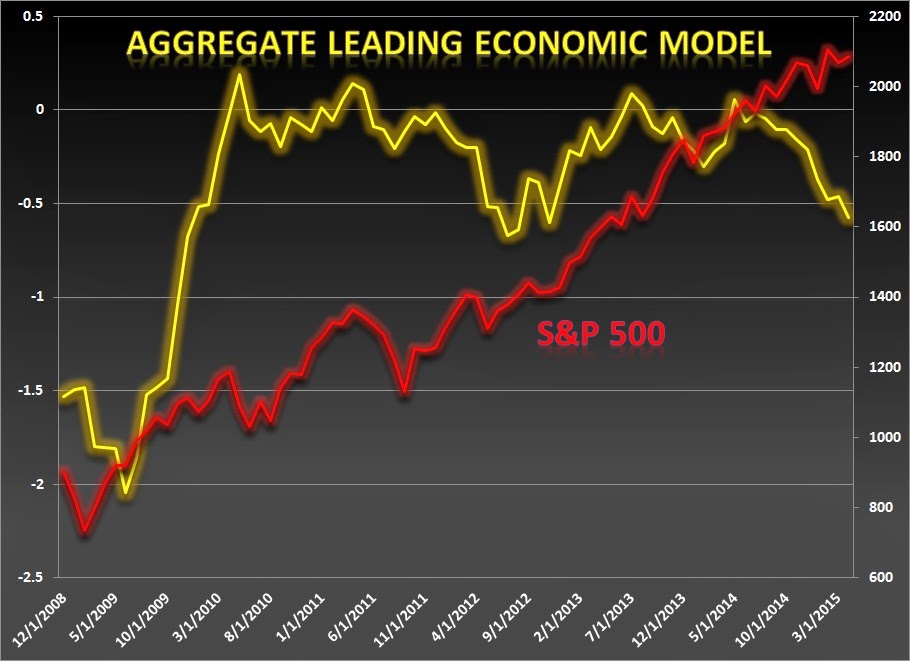
When tracking the economy, I like to aggregate several leading indicators into a single easy to read economic gauge. The variables that I input into the model are U.S. Average Weekly Manufacturing Hours, U.S. Manufacturers New Orders Consumer Goods, the Conference Board U.S. Leading Index Vendor Performance, the Conference Board U.S. Manufacturers New Orders Non-Defense Capital Goods, M2 Money Supply and University of Michigan Consumer Expectations. The chart below places this model against the S&P 500. The trend for the economic model is trending lower and yet the S&P 500 remains unfazed by the seeming economic slowdown. The stock market is the ultimate leading indicator and I always default to the market knows best discipline but this divergence is worrisome (the last time such a divergence occurred was the 2011 market correction).


The Citigroup Economic Surprise Index is also showing how far the general economic consensus is off from reality. This index isn’t exactly a pure reading on economic growth but more of a reading of economist forecasts versus the actual economic releases. It is telling us that the forecasts that are published are probably too optimistic and need to be trimmed.


Climbing the Wall of Worry

April 30, 2015 CNBC – “Marc Faber: Stocks are about to fall 40%—at least! “The market is in a position where it's not just going to be a 10 percent correction. Maybe it first goes up a bit further, but when it comes, it will be 30 percent or 40 percent minimum!" Faber asserted. Faber says low yields and stimulative central bank policies around the world have led to a condition in which "all assets are grossly overvalued … and eventually this will unwind and cause some problems."”

April 30, 2015 CNBC – “It's going to get ugly, says Dennis Gartman. "It's not going to get ugly bad; it's not going to get ugly for a long period of time. I think it's going to get ugly swiftly and I think it's going to make a lot of people very nervous," the editor and publisher of The Gartman Letter said in an interview with CNBC's "Closing Bell" on Thursday. He expects the downturn to last two to three weeks, and said then it'll be time to buy again.”

May 1, 2015 CNBC – “Mario Gabelli: There's no margin of safety in stocks. “As we look into 2016 ... I'm [also] looking at the economy in Europe picking up. The American companies will do a lot better because of earnings in Europe coming into the U.S.," he predicted in a CNBC "Squawk Box" interview. "The [U.S. stock] market is a function of earnings, and we're comfortable with that." He warned, however, that "on balance there's no margin of safety. If something goes wrong, you'll have the volatility that you had [Thursday]." The Dow Jones Industrial Average, the S&P 500, and the Nasdaq Composite Index closed lower in a choppy session on the final trading day of April, which did finish positive, but just barely.”

May 4, 2015 Business Insider – “We haven't heard Carl Icahn this bearish in a long time. He told hosts Anthony Scaramucci and Gary Kaminsky that his portfolio was hedged for a correction. "I'm very concerned about the market," he said. "I think that you have a situation where this market keeps going up ... and yet a lot of the economic news isn't all that good, and also more importantly, earnings aren't good." The bottom line, to Icahn, is that some stocks are trading at 17 and 18 times the S&P. Those same stocks are going to whiff earnings. What rational person would buy that?”

May 4, 2015 Business Insider – “BUFFETT: Stocks won't look cheap if interest rates rise. Stocks are definitely on the "high side of valuation," Berkshire Hathaway CEO Warren Buffett says.”


May 4, 2015 Monthly Investment Outlook from Bill Gross – “Policymakers and asset market bulls, on the other hand speak to the possibility of normalization – a return to 2% growth and 2% inflation in developed countries which may not initially be bond market friendly, but certainly fortuitous for jobs, profits, and stock markets worldwide. Their “New Normal” as I reaffirmed most recently at a Grant’s Interest Rate Observer quarterly conference in NYC, depends on the less than commonsensical notion that a global debt crisis can be cured with more and more debt. At that conference I equated such a notion with a similar real life example of pouring lighter fluid onto a barbeque of warm but not red hot charcoal briquettes in order to cook the spareribs a little bit faster. Disaster in the form of burnt ribs was my historical experience. It will likely be the same for monetary policy, with its QE’s and now negative interest rates that bubble all asset markets.

But for the global economy, which continues to lever as opposed to delever, the path to normalcy seems blocked. Structural elements – the New Normal and secular stagnation, which are the result of aging demographics, high debt/GDP, and technological displacement of labor, are phenomena which appear to have stunted real growth over the past five years and will continue to do so. Even the three strongest developed economies – the U.S., Germany, and the U.K. – have experienced real growth of 2% or less since Lehman. If trillions of dollars of monetary lighter fluid have not succeeded there (and in Japan) these past 5 years, why should we expect Draghi, his ECB, and the Eurozone to fare much differently?”

May 6, 2015 Bloomberg Business – “Yellen Says Stock Valuations ‘Quite High,’ Bond Yields Low. Federal Reserve Chair Janet Yellen, surveying the financial landscape for signs of bubbles after more than six years of near-zero rates, warned that both stocks and bonds are richly valued.” “I would highlight that equity-market valuations at this point generally are quite high,” Yellen said in Washington on Wednesday in response to a question at a forum on finance. “Now, they’re not so high when you compare the returns on equities to the returns on safe assets like bonds, which are also very low, but there are potential dangers there.””

May. 8, 2015 Seeking Alpha – ”Signs Of A Stock Market Correction Developing - My view is that price action in the stock market is hinting at some possible "changing winds" in the days, weeks and months ahead. If the break of the ascending triangle in the short-term chart is confirmed, and if the market subsequently breaks and confirms a break of the lower channel trend line in the longer-term chart (the break has not happened yet), I think the market may be set up to enter into a corrective phase.” -  James A. Kostohryz.

May 12, 2015 Business Insider – “HARRY DENT: 'The curtains are falling for the greatest bull market and bubble in history' - We’ve been in an unprecedented period since late 2008 wherein central banks around the world have stepped in and printed whatever amount of money they deemed necessary. They’re desperately trying to stop the depression and deflation meltdown that started in the second half of that year.

But there is a limit to how much you can stimulate an economy pointing down… especially one already up to debt levels twice that of the last great bubble boom that peaked in 1929 — 4 times if you include unfunded entitlements. Just how much more can you get people and companies to spend and borrow when they already way overdid that? The answer is, you can’t.”

Risk Management

There is always the treat of a correction or bear market on the horizon but it is truly impossible to forecast when it will happen. In the cases of market “bubbles”, market sentiment has much more influence on asset prices than intrinsic values. Attempting to time market tops and bottoms is a futile and unprofitable strategy in my opinion. Understanding the fallacy of the Efficient Market Hypothesis and the Efficient Frontier and embracing the influence investor behavior can have on market valuations is one of the hardest parts of investing.

We have written in the past about our concerns about the market valuation but have an equally sound concern about missing potential market gains by ignoring the power of investor sentiment. The proper use of portfolio risk management while maintaining equity exposure is the most prudent option right now, in our opinion. Building cash from dividends and interest and the use of options is reasonable. We acknowledge providing liquidity using call options on our positions in the near-term and taking liquidity using put option on our positions on a longer term prospective will create a collared strategy that will minimize the damage should a sudden shift occur. This strategy also keeps the portfolio insurance costs under control.

With the proper risk management in place, we are not only prepared for a correction but actually encourage it. When following a concave constant mix portfolio structure, it allows us to reposition the holdings in the portfolio to take advantage of new opportunities. Most of the alpha generated within the portfolio comes from such events in our experience.

Joseph S. Kalinowski, CFA

No part of this report may be reproduced in any manner without the expressed written permission of Squared Concept Partners, LLC.  Any information presented in this report is for informational purposes only.  All opinions expressed in this report are subject to change without notice.  Squared Concept Partners, LLC is an independent asset management and consulting company. These entities may have had in the past or may have in the present or future long or short positions, or own options on the companies discussed.  In some cases, these positions may have been established prior to the writing of the particular report. 

The above information should not be construed as a solicitation to buy or sell the securities discussed herein.  The publisher of this report cannot verify the accuracy of this information.  The owners of Squared Concept Partners, LLC and its affiliated companies may also be conducting trades based on the firm’s research ideas.  They also may hold positions contrary to the ideas presented in the research as market conditions may warrant. 

This analysis should not be considered investment advice and may not be suitable for the readers’ portfolio. This analysis has been written without consideration to the readers’ risk and return profile nor has the readers’ liquidity needs, time horizon, tax circumstances or unique preferences been taken into account. Any purchase or sale activity in any securities or other instrument should be based upon the readers’ own analysis and conclusions. Past performance is not indicative of future results.


Saturday, May 2, 2015

An Upside To The Oil Market?

I recently wrote an article for TraderPlanet that outlines the possible virtues of having oil exposure in one's portfolio. I'd like to thank TraderPlanet for the opportunity and platform to share my ideas.

http://www.traderplanet.com/articles/view/168234-an-upside-to-the-oil-market/

Joseph S. Kalinowski, CFA

More on Liquidity Risk


 A few weeks ago I wrote a piece called “The Looming Crisis” that spoke about the possible liquidity risk on the horizon that was first brought to light by Jamie Dimon in his shareholder letter. In the blog I wrote “Jamie Dimon rattled the financial world with his shareholder letter last week basically saying there exists another crisis looming. He writes, “Treasury markets were quite turbulent in the spring and summer of 2013, when the Fed hinted that it soon would slow its asset purchases. Then on one day, October 15, 2014, Treasury securities moved 40 basis points, statistically 7 to 8 standard deviations – an unprecedented move – an event that is supposed to happen only once in every 3 billion years or so (the Treasury market has only been around for 200 years or so – of course, this should make you question statistics to begin with). Some currencies recently have had similar large moves. Importantly, Treasuries and major country currencies are considered the most standardized and liquid financial instruments in the world. The good news is that almost no one was significantly hurt by this, which does show good resilience in the system. But this happened in what we still would consider a fairly benign environment. If it were to happen in a stressed environment, it could have far worse consequences.””

Since then I have seen many market experts coming out to reiterate and confirm such fears.

Mar. 25, 2015 - HOWARD MARKS: Liquidity is not how easily you can sell something – Business Insider: “Marks' note comes on the heels of this report from the Financial Times on Monday, which cited a number of investors in the bond market who are worried about a potential liquidity crunch in markets.”

Apr. 15, 2015- FED OFFICIAL: We risk a market bubble if we don't move on monetary policy – Reuters (via Business Insider): “"A risk of remaining at the zero lower bound too long is that a significant asset market bubble will develop,” St. Louis Federal Reserve Bank President James Bullard said in prepared remarks.”

Apr. 15, 2015 - STAN DRUCKENMILLER: I just know this is going to end badly; I can feel it in my bones – Business Insider: “Druckenmiller, 61, accurately called the housing crisis. During his speech, he said that he has the same horrific feeling now as he did back then.”

Apr. 15, 2015  Marc Faber says Short Central Banks and Buy Gold – Marc Faber Blog: “I think that my bet is that if i could short central banks i would short central banks in 2015 because I think that investors will suddenly realise what a scam central banking is and then they will lose confidence. And there is only one way to short central banks and that is to buy gold.”

Apr. 20, 2015 - The IMF's scary warning about the bond market might not be scary enough – Business Insider: “One word is starting to come up over and over again in markets: liquidity. On Sunday, Business Insider's David Scutt wrote about a recent report from the IMF that warned about the risks of market liquidity disappearing in times of financial stress, exacerbating market reaction to certain events.”

Mile wide, inch deep - Bond market liquidity dries up – Ben Eisen on liquidity risk: “These market shifts are set against the backdrop of a widespread fear that investors will leave the bond markets en masse as interest rates rise”

Apr. 20, 2015 - Half a Bubble Off Dead Center - John Mauldin: “My dad used to say about a situation that just didn’t seem quite right that things were “about a half a bubble off dead center.” (This was back in the days when we used bubble levels to determine whether something was level or plumb – before today’s fancy digital gadgets.) There is a reason, I think, that everything seems just a little out of kilter. I believe that central banks, in their valiant, unceasing efforts to restore liquidity and growth, have unleashed numerous unintended consequences that are beginning to show up in earnest.”

Apr. 22, 2015 - Bank of Mexico Governor sees 'asset bubbles' and the 'illusion of liquidity' – Business Insider: “Given the magnitude of the crisis, “unconventional monetary policies have been essential and have worked so far,” he said, toeing the line. But “it’s too early to declare victory.” We “still have to see if the unwinding of those policies can proceed in an orderly fashion.” But even if the unwinding is not orderly, it’s “unavoidable.” Otherwise, they’d “feed into inflation and induce higher than warranted interest rates and financial instability.””

Apr. 23, 2015 - The Fed is trying to avoid a 'nightmare scenario' – Business Insider: “(Reuters) - Sections of the U.S. financial system that may be vulnerable to investor panic are raising concerns inside the Federal Reserve, as policymakers preparing for the first interest-rate hike in nearly a decade seek to ensure that the market is ready and able to handle it whenever it happens. The Fed is particularly worried about whether the booming asset management industry can withstand a run of redemptions in a financial crisis.”

Apr. 23, 2015 - Here's why money managers pose a systemic risk – Business Insider: “As stock markets move to new highs, asset managers are booming, with vast inflows into bond and equity funds alike. The IMF has pointed out the potentially systemic risks created by concentrated pools of inflated and increasingly correlated assets. It is now time for regulators around the world to recognize the risks inherent in asset managers and funds that are too big to fail.”

Apr. 24, 2015 - The Next Bubble Is A Matter of If Not When – Fox Business: “Many analysts believe the Fed’s so-called ‘easy money’ policies initiated in the wake of the 2008 financial crisis have helped push U.S. stock indexes to new records and bond prices to their highest levels in decades. “By manipulating interest rates the Fed creates circumstances that lead to an expansion in the financial markets that ultimately has to contract,” said Roberts. “In other words we get these booms and busts.””

Apr. 26, 2015 - The market is getting nervous about something experts are struggling to define – Business Insider: “Since the bond market's "flash crash" back in October — when US 10-year Treasury yields fell 34 basis points, or 0.34% in one morning — concerns regarding liquidity and how resilient the bond market might be to shocks have lingered around the market. In the Minutes from the Fed's January policy meeting, we noted that the Fed was clearly starting to worry about liquidity.”

I am not one to fear monger but as I wrote in the blog two weeks ago, there does seem to be some market distortions that have led to an over-valued situation. While I can’t be sure, my initial assumption is that these distortions have been created by unprecedented and unorthodox monetary policy that has been initiated since the great recession. Should there be a mass run for the exits, the liquidity environment could accentuate losses in one’s portfolio.

Just something to keep an eye on.

Joseph S. Kalinowski, CFA
 
No part of this report may be reproduced in any manner without the expressed written permission of Squared Concept Partners, LLC.  Any information presented in this report is for informational purposes only.  All opinions expressed in this report are subject to change without notice.  Squared Concept Partners, LLC is an independent asset management and consulting company. These entities may have had in the past or may have in the present or future long or short positions, or own options on the companies discussed.  In some cases, these positions may have been established prior to the writing of the particular report. 
The above information should not be construed as a solicitation to buy or sell the securities discussed herein.  The publisher of this report cannot verify the accuracy of this information.  The owners of Squared Concept Partners, LLC and its affiliated companies may also be conducting trades based on the firm’s research ideas.  They also may hold positions contrary to the ideas presented in the research as market conditions may warrant. 
This analysis should not be considered investment advice and may not be suitable for the readers’ portfolio. This analysis has been written without consideration to the readers’ risk and return profile nor has the readers’ liquidity needs, time horizon, tax circumstances or unique preferences been taken into account. Any purchase or sale activity in any securities or other instrument should be based upon the readers’ own analysis and conclusions. Past performance is not indicative of future results.